Welding Automation for Heavy Industry
Heavy industry welding automation for tanks, containers, steel structures, mining machinery, oil & gas and pipelines—improve productivity and lower total cost.
Industrial Applications of Meng Welding Robot
Outdoor/Repair · Client Feedback · Simulation vs. Reality (click to play, loads only on demand)


Outdoor & Repair Welding|On‑Site Constraints & Stable Results
Two field-style clips focused on real constraints: uneven surfaces, wind/contamination, limited access, and how to keep a stable arc with practical parameter choices, path planning, and quick pre‑weld checks.


Feedback of Clients|Deployment Outcomes & ROI Signals
Customer perspective in two formats: what improved after deployment (cycle time, consistency, training effort), what issues appeared early (fixtures, teaching time), and the key indicators they used to judge ROI.

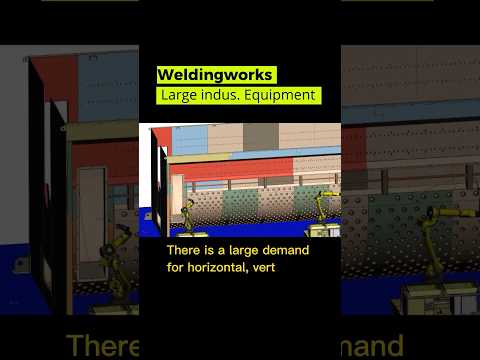
Simulation vs. Reality|Calibration, Offsets & Real-World Deviations
A practical comparison of “why sim ≠ reality”: calibration drift, tool/work offsets, fixture tolerances, and how small compensation steps (touch-up, re-teach strategy, speed/blend tweaks) close the gap.
Applications Overview: Industries Served, Typical Workpieces & Automation Outcomes
Industries Served
- Heavy fabrication industries with large parts and long seams.
- Supports production, installation, and repair scenarios.
- Works across standardized lines and mixed, non-standard jobs.
Typical Workpieces
- Tanks & pressure parts, long ducts/pipelines, large panels and frames.
- Handles heavy-duty workpieces and thick sections.
- Fits both fixture-based and flexible setups.
Why Automation
- Improve throughput and stabilize quality in long-seam production.
- Reduce labor dependence and simplify repeatable jobs.
- Enable repair/field tasks with controlled welding parameters.
Outcomes
- Higher productivity with more stable takt time and arc-on time.
- Better weld consistency, fewer defects, and less rework.
- Lower total cost with standardized processes and repeatability.